
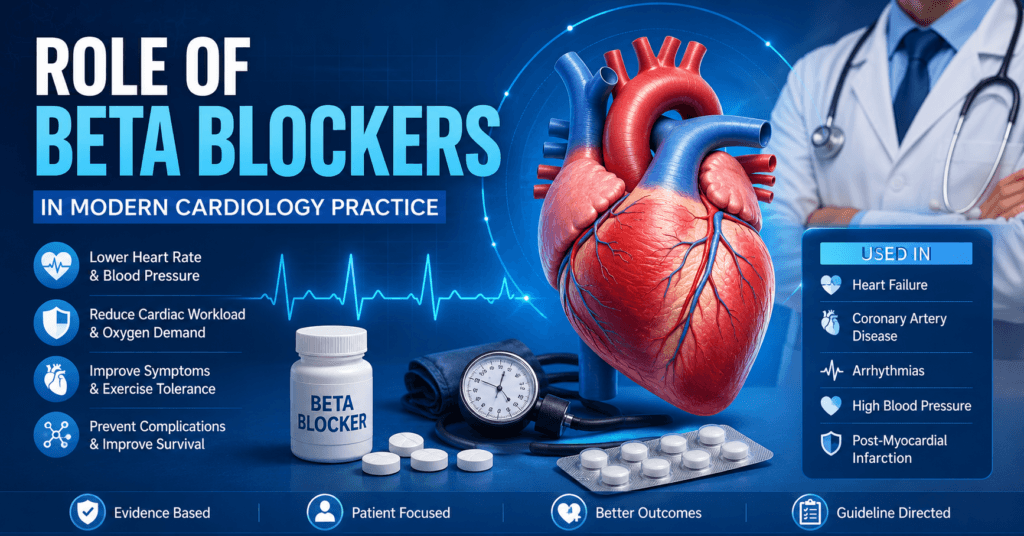
Role of Beta Blockers in Modern Cardiology Practice…!
Beta blockers remain one of the most important medications in cardiovascular medicine. Although many newer drugs have become available over the last two decades, the Role of Beta Blockers continues to be significant in selected cardiac conditions.
These medicines reduce the effects of adrenaline on the heart ( important role of beta blockers), thereby lowering heart rate, decreasing blood pressure, and reducing the heart’s oxygen demand. As a result, they improve symptoms, prevent complications, and increase survival in several cardiovascular diseases.
However, modern cardiology has also changed the way and the role of beta blockers are prescribed. Today, they are recommended for specific indications rather than being used routinely for every patient with heart disease. Therefore, understanding current role of beta blockers helps clinicians provide evidence based care while avoiding unnecessary treatment.
What Are Beta Blockers?
Beta blockers are medications that block beta-adrenergic receptors. Consequently, they reduce the stimulation of the heart by stress hormones such as adrenaline and noradrenaline. This leads to a slower heart rate, lower blood pressure, and reduced myocardial oxygen consumption.
Commonly prescribed beta blockers include:
- Metoprolol Succinate
- Bisoprolol
- Carvedilol
- Nebivolol
- Atenolol
- Propranolol
- Esmolol (intravenous)
How Beta Blockers Work
The Role of Beta Blockers is based on their ability to inhibit beta receptors in the heart and blood vessels. As a result, they produce several beneficial cardiovascular effects.
- Reduce heart rate
- Lower myocardial oxygen demand
- Decrease blood pressure
- Reduce cardiac workload
- Suppress abnormal heart rhythms
- Improve ventricular filling time
- Reduce the risk of sudden cardiac death in selected patients
Major Clinical Uses in Modern Cardiology
1. Heart Failure with Reduced Ejection Fraction (HFrEF)
Evidence strongly supports beta blockers in patients with HFrEF. Large clinical trials have shown significant reductions in mortality and hospital admissions when evidence-based beta blockers are used together with guideline-directed medical therapy.
The recommended agents include:
- Bisoprolol
- Carvedilol
- Metoprolol Succinate
Treatment should begin with a low dose and be increased gradually while monitoring heart rate, blood pressure, and symptoms.
2. Acute Coronary Syndrome and Previous Myocardial Infarction
The Role of Beta Blockers remains important after myocardial infarction, particularly in patients with reduced left ventricular function or heart failure. These medications reduce recurrent ischemia, improve survival, and decrease the incidence of ventricular arrhythmias.
However, current guidelines recommend individualized treatment because not every patient requires lifelong beta blocker therapy after an uncomplicated myocardial infarction.
3. Stable Angina
Beta blockers remain first-line therapy for chronic stable angina. By slowing the heart rate, they reduce myocardial oxygen demand and improve exercise tolerance. Consequently, many patients experience fewer episodes of chest pain.
4. Cardiac Arrhythmias
Beta blockers play a major role in rhythm management. They are frequently prescribed for:
- Atrial fibrillation rate control
- Supraventricular tachycardia
- Premature ventricular complexes
- Long QT syndrome
- Catecholaminergic polymorphic ventricular tachycardia
5. Hypertension
Although beta blockers were once considered first-line therapy for hypertension, current guidelines recommend them mainly when patients have additional cardiac conditions such as coronary artery disease, heart failure, atrial fibrillation, or a previous myocardial infarction.
Modern Evidence: When Beta Blockers Are Less Beneficial
Recent studies have changed clinical practice. Beta blockers are no longer routinely prescribed for every cardiovascular patient. Instead, therapy should be guided by individual patient characteristics and current clinical guidelines.
For example, patients with uncomplicated hypertension often benefit more from ACE inhibitors, ARBs, calcium channel blockers, or thiazide diuretics unless there is another indication for beta blocker therapy.
Benefits of Beta Blockers
| Benefit | Clinical Importance |
|---|---|
| Lower heart rate | Reduces myocardial oxygen demand |
| Decrease blood pressure | Improves cardiovascular protection |
| Reduce angina | Improves exercise tolerance |
| Control arrhythmias | Prevents rapid heart rhythms |
| Improve HFrEF survival | Reduces mortality and hospitalization |
| Reduce sudden cardiac death | Especially after myocardial infarction |
Common Side Effects
Although beta blockers are generally safe, clinicians should monitor patients for possible adverse effects.
- Bradycardia
- Hypotension
- Fatigue
- Dizziness
- Cold hands and feet
- Depression (less common)
- Sexual dysfunction
- Bronchospasm in susceptible patients
Contraindications
Beta blockers should be avoided or used cautiously in certain situations.
- Severe symptomatic bradycardia
- Second- or third-degree AV block without a pacemaker
- Cardiogenic shock
- Acute decompensated heart failure
- Severe uncontrolled asthma
Choosing the Right Beta Blocker
| Clinical Condition | Preferred Beta Blocker |
|---|---|
| Heart Failure (HFrEF) | Bisoprolol, Carvedilol, Metoprolol Succinate |
| Coronary Artery Disease | Metoprolol, Bisoprolol |
| Atrial Fibrillation | Metoprolol, Bisoprolol |
| Hypertension with CAD | Nebivolol, Bisoprolol |
| Acute Arrhythmia | Esmolol (IV) |
Practical Tips for Clinicians
- Start with low doses and increase gradually.
- Monitor heart rate and blood pressure regularly.
- Avoid abrupt discontinuation because rebound tachycardia and ischemia may occur.
- Choose cardioselective beta blockers in patients with mild COPD when clinically indicated.
- Combine beta blockers with guideline-directed therapies for heart failure.
Conclusion
The Role of Beta Blockers has evolved significantly in modern cardiology. While they are no longer prescribed routinely for every cardiovascular patient, they remain lifesaving in heart failure with reduced ejection fraction, post-myocardial infarction patients with left ventricular dysfunction, chronic stable angina, and many cardiac arrhythmias. Furthermore, individualized treatment based on current evidence ensures maximum benefit while minimizing unnecessary exposure to side effects. As modern cardiovascular care continues to evolve, beta blockers remain an essential component of evidence-based cardiology practice.
Read more on MedicalsWeb:
References:
- 2025 ESC Guidelines for the Management of Cardiovascular Diseases
- 2022 AHA/ACC/HFSA Guideline for the Management of Heart Failure
- Braunwald’s Heart Disease, 13th Edition