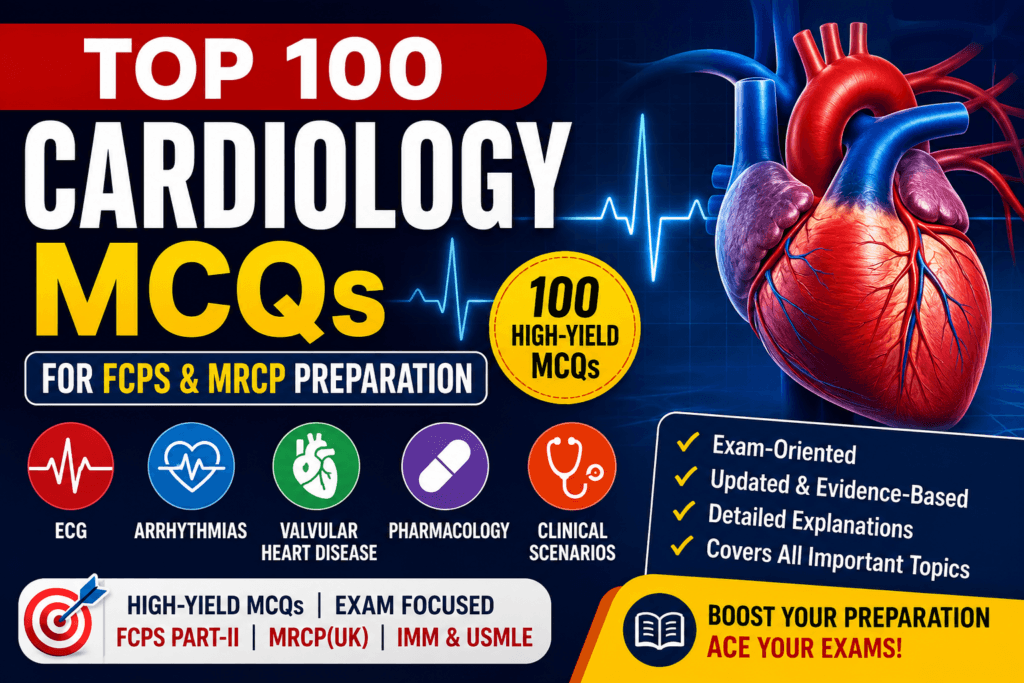
Top Cardiology MCQs for FCPS and MRCP Preparation…;
Preparing for postgraduate medical examinations requires more than simply memorizing facts. Success in FCPS and MRCP depends on understanding clinical concepts, applying evidence-based medicine, and practicing high-quality multiple-choice questions (MCQs). Therefore, solving the right MCQs for FCPS and MRCP can significantly improve your clinical reasoning and exam performance.
Cardiology remains one of the highest-yield subjects in both examinations. Questions commonly focus on electrocardiography (ECG), acute coronary syndrome, heart failure, valvular heart disease, arrhythmias, hypertension, and cardiovascular pharmacology. Consequently, regular MCQ practice strengthens knowledge while improving speed and confidence during the examination.
Instead of memorizing answers, understand why each option is correct or incorrect. This strategy improves long-term retention and prepares you for clinical scenarios in FCPS Part-II, MRCP PACES, and everyday medical practice.
Top Cardiology MCQs for FCPS and MRCP
MCQ 1
A 58-year-old man presents with severe central chest pain lasting one hour. ECG shows ST elevation in leads II, III, and aVF. Which coronary artery is most likely occluded?
A. Left Main Coronary Artery
B. Left Anterior Descending Artery
C. Right Coronary Artery
D. Circumflex Artery
Correct Answer: C. Right Coronary Artery
Inferior wall myocardial infarction is usually caused by occlusion of the right coronary artery. Therefore, ST elevation in leads II, III, and aVF strongly suggests RCA involvement.
MCQ 2
Which cardiac biomarker is most specific for diagnosing acute myocardial infarction?
A. CK-MB
B. LDH
C. Troponin I
D. AST
Correct Answer: C. Troponin I
Troponin I is highly sensitive and specific for myocardial injury. Consequently, it has become the preferred biomarker in modern cardiology practice.
MCQ 3
Which drug should be administered immediately in acute STEMI unless contraindicated?
A. Aspirin
B. Digoxin
C. Amiodarone
D. Verapamil
Correct Answer: A. Aspirin
Early administration of aspirin significantly reduces mortality by inhibiting platelet aggregation. Therefore, every suspected STEMI patient should receive aspirin unless contraindications exist.
MCQ 4
Which heart valve is most commonly affected by rheumatic heart disease?
A. Pulmonary Valve
B. Aortic Valve
C. Mitral Valve
D. Tricuspid Valve
Correct Answer: C. Mitral Valve
Rheumatic fever most frequently damages the mitral valve, resulting in mitral stenosis or mitral regurgitation.
MCQ 5
Which arrhythmia carries the greatest risk of sudden cardiac death if untreated?
A. Sinus Tachycardia
B. Atrial Flutter
C. Ventricular Fibrillation
D. First-Degree AV Block
Correct Answer: C. Ventricular Fibrillation
Ventricular fibrillation produces no effective cardiac output. Consequently, immediate defibrillation is lifesaving.
MCQ 6
Which antihypertensive medication is contraindicated during pregnancy?
A. Methyldopa
B. Labetalol
C. Nifedipine
D. Enalapril
Correct Answer: D. Enalapril
ACE inhibitors are contraindicated during pregnancy because they may cause fetal renal abnormalities and other congenital complications.
MCQ 7
Which ECG finding is characteristic of hyperkalemia?
A. Delta Wave
B. Peaked T Waves
C. ST Depression
D. U Waves
Correct Answer: B. Peaked T Waves
Hyperkalemia classically produces tall, narrow, peaked T waves. As potassium levels continue to rise, QRS widening and ventricular arrhythmias may occur.
MCQ 8
Which medication has been shown to improve survival in heart failure with reduced ejection fraction (HFrEF)?
A. Digoxin Alone
B. ACE Inhibitors
C. Verapamil
D. Diltiazem
Correct Answer: B. ACE Inhibitors
ACE inhibitors reduce mortality, improve symptoms, and slow disease progression in patients with HFrEF.
Quick Revision Points
- Inferior MI → Right Coronary Artery
- Best biomarker → Troponin I
- First drug in STEMI → Aspirin
- Most common rheumatic valve → Mitral Valve
- Deadliest arrhythmia → Ventricular Fibrillation
- ACE inhibitors are contraindicated in pregnancy.
- Hyperkalemia → Peaked T waves
- ACE inhibitors improve survival in HFrEF.
For additional cardiology learning, you can also read our articles on
Heart Health in Diabetes
and
Can Stress Really Cause Heart Problems?,
which explain important cardiovascular concepts frequently tested in postgraduate examination.
More High-Yield Cardiology MCQs for FCPS and MRCP
MCQ 9
Which murmur is classically associated with aortic stenosis?
A. Early diastolic murmur
B. Pansystolic murmur
C. Ejection systolic murmur radiating to the carotids
D. Continuous machinery murmur
Correct Answer: C. Ejection systolic murmur radiating to the carotids
Aortic stenosis typically presents with a harsh ejection systolic murmur that radiates toward the carotid arteries. Therefore, careful auscultation remains an important clinical skill.
MCQ 10
Which antihypertensive drug is considered first-line in most patients with heart failure and reduced ejection fraction?
A. Verapamil
B. ACE Inhibitor
C. Digoxin
D. Hydrochlorothiazide
Correct Answer: B. ACE Inhibitor
ACE inhibitors reduce mortality and hospital admissions. Consequently, they form the foundation of guideline-directed therapy.
MCQ 11
Which ECG finding is most suggestive of acute pericarditis?
A. ST depression only
B. Diffuse ST elevation with PR depression
C. Pathological Q waves
D. Peaked T waves
Correct Answer: B. Diffuse ST elevation with PR depression
MCQ 12
The drug of choice for stable angina symptom relief is:
A. Nitroglycerin
B. Digoxin
C. Adenosine
D. Atropine
Correct Answer: A. Nitroglycerin
MCQ 13
Which congenital heart disease is known as the most common cyanotic congenital heart disease?
A. ASD
B. VSD
C. Tetralogy of Fallot
D. PDA
Correct Answer: C. Tetralogy of Fallot
MCQ 14
Which electrolyte abnormality commonly causes U waves on ECG?
A. Hyperkalemia
B. Hypokalemia
C. Hypercalcemia
D. Hypermagnesemia
Correct Answer: B. Hypokalemia
MCQ 15
Which medication is recommended for rapid rate control in stable atrial fibrillation?
A. Adenosine
B. Metoprolol
C. Atropine
D. Lidocaine
Correct Answer: B. Metoprolol
MCQ 16
Which investigation is considered the gold standard for diagnosing coronary artery disease?
A. ECG
B. Echocardiography
C. Coronary Angiography
D. Chest X-ray
Correct Answer: C. Coronary Angiography
Quick High-Yield Revision Table
| Topic | High-Yield Point |
|---|---|
| STEMI | Aspirin immediately unless contraindicated. |
| Inferior MI | Right Coronary Artery |
| Hyperkalemia | Peaked T Waves |
| Hypokalemia | U Waves |
| Pericarditis | Diffuse ST elevation + PR depression |
| Heart Failure | ACE inhibitors improve survival. |
| Aortic Stenosis | Murmur radiates to carotids. |
| Gold Standard CAD | Coronary Angiography |
Preparation Tips for FCPS and MRCP
- Practice MCQs every day instead of studying only textbooks.
- Review explanations carefully, even after answering correctly.
- Focus on current ESC, ACC, and AHA guideline recommendations.
- Interpret ECGs daily to improve pattern recognition.
- Revise cardiovascular pharmacology regularly.
- Solve previous FCPS and MRCP recall questions.
- Study clinical scenarios rather than isolated facts.
Exam Success Tip
Don’t just memorize answers—understand the concept behind every question. Clinical reasoning is what separates successful FCPS and MRCP candidates from the rest.
Recommended Reading
- Heart Health in Diabetes
- Can Stress Really Cause Heart Problems?
- European Society of Cardiology (ESC)
- American Heart Association (AHA)
- https://www.medicalsweb.com/smoking/
MCQ 17
Which antiarrhythmic drug is preferred for stable ventricular tachycardia?
A. Digoxin
B. Adenosine
C. Amiodarone
D. Verapamil
Answer: C. Amiodarone
Amiodarone is commonly used for stable ventricular tachycardia because it suppresses ventricular arrhythmias effectively.
MCQ 18
Which lipid abnormality is the strongest risk factor for coronary artery disease?
A. High HDL
B. Elevated LDL cholesterol
C. Low triglycerides
D. High VLDL only
Answer: B. Elevated LDL cholesterol
LDL cholesterol promotes atherosclerosis. Therefore, lowering LDL remains a major treatment goal.
MCQ 19
Which heart sound is associated with heart failure?
A. S1
B. S2
C. S3 Gallop
D. Opening Snap
Answer: C. S3 Gallop
An S3 gallop suggests volume overload and is commonly heard in systolic heart failure.
MCQ 20
Which ECG lead best reflects the anterior wall of the heart?
A. II, III, aVF
B. V1–V4
C. I and aVL
D. V5–V6
Answer: B. V1–V4
Anterior wall myocardial infarction typically produces ST elevation in leads V1 through V4.
MCQ 21
Which investigation is most useful for assessing left ventricular ejection fraction?
A. Chest X-ray
B. ECG
C. Echocardiography
D. Cardiac Enzymes
Answer: C. Echocardiography
Echocardiography provides accurate assessment of ventricular size, function, and ejection fraction.
MCQ 22
Which condition commonly causes atrial fibrillation?
A. Hyperthyroidism
B. Hypothyroidism
C. Appendicitis
D. Peptic ulcer disease
Answer: A. Hyperthyroidism
Hyperthyroidism increases sympathetic activity and is a recognized reversible cause of atrial fibrillation.
MCQ 23
Which drug is the antidote for warfarin overdose with major bleeding?
A. Vitamin C
B. Vitamin D
C. Vitamin K
D. Calcium Gluconate
Answer: C. Vitamin K
Vitamin K reverses the anticoagulant effect of warfarin. In severe bleeding, prothrombin complex concentrate may also be required.
MCQ 24
Which murmur increases during inspiration?
A. Mitral Regurgitation
B. Aortic Stenosis
C. Tricuspid Regurgitation
D. Mitral Stenosis
Answer: C. Tricuspid Regurgitation
Right-sided murmurs become louder during inspiration because venous return increases.
MCQ 25
Which medication should routinely be prescribed after myocardial infarction unless contraindicated?
A. Aspirin
B. Antibiotics
C. Prednisolone
D. Verapamil
Answer: A. Aspirin
Aspirin reduces recurrent cardiovascular events and remains a cornerstone of secondary prevention.
MCQ 26
Which arrhythmia is characterized by an irregularly irregular pulse?
A. Atrial Flutter
B. Sinus Tachycardia
C. Atrial Fibrillation
D. AVNRT
Answer: C. Atrial Fibrillation
An irregularly irregular rhythm without distinct P waves is the hallmark of atrial fibrillation.
MCQ 27
Which medication is recommended for high-intensity lipid lowering after acute coronary syndrome?
A. Simvastatin 10 mg
B. Atorvastatin 80 mg
C. Gemfibrozil
D. Niacin
Answer: B. Atorvastatin 80 mg
High-intensity statin therapy is recommended following acute coronary syndrome according to current guidelines.
MCQ 28
Which congenital heart disease produces a machinery murmur?
A. ASD
B. VSD
C. PDA
D. TOF
Answer: C. Patent Ductus Arteriosus
A continuous machinery murmur is characteristic of patent ductus arteriosus.
MCQ 29
The most common cause of infective endocarditis is:
A. Streptococcus pneumoniae
B. Staphylococcus aureus
C. Salmonella
D. Klebsiella
Answer: B. Staphylococcus aureus
Staphylococcus aureus is now the leading cause of infective endocarditis in many populations.
MCQ 30
Which ECG change is commonly seen in hypocalcemia?
A. Short QT interval
B. Prolonged QT interval
C. Tall T waves
D. ST elevation
Answer: B. Prolonged QT Interval
Hypocalcemia prolongs ventricular repolarization, resulting in QT prolongation.
MCQ 31
Which beta-blocker has proven mortality benefit in chronic heart failure?
A. Atenolol
B. Carvedilol
C. Propranolol
D. Esmolol
Answer: B. Carvedilol
Carvedilol, bisoprolol, and sustained-release metoprolol improve survival in HFrEF.
MCQ 32
Which condition is the most common cause of sudden cardiac death in young athletes?
A. Rheumatic Heart Disease
B. Hypertrophic Cardiomyopathy
C. Mitral Valve Prolapse
D. Atrial Septal Defect
Answer: B. Hypertrophic Cardiomyopathy
Hypertrophic cardiomyopathy is the leading cause of sudden cardiac death in young athletes. Therefore, early diagnosis and risk assessment are extremely important.
MCQ 33
Which medication is the first-line treatment for symptomatic bradycardia?
A. Adenosine
B. Amiodarone
C. Atropine
D. Digoxin
Answer: C. Atropine
Atropine is recommended as the initial drug for symptomatic bradycardia. However, temporary pacing may become necessary if atropine is ineffective.
MCQ 34
Which valve lesion produces a mid-diastolic murmur with an opening snap?
A. Mitral Stenosis
B. Mitral Regurgitation
C. Aortic Stenosis
D. Tricuspid Regurgitation
Answer: A. Mitral Stenosis
Mitral stenosis classically presents with an opening snap followed by a low-pitched mid-diastolic murmur.
MCQ 35
Which medication is commonly used to terminate paroxysmal supraventricular tachycardia (PSVT)?
A. Aspirin
B. Adenosine
C. Digoxin
D. Furosemide
Answer: B. Adenosine
Adenosine temporarily blocks AV nodal conduction and is highly effective in AV node-dependent tachycardias.
MCQ 36
Which condition commonly causes left ventricular hypertrophy?
A. Chronic Hypertension
B. Asthma
C. COPD
D. Hyperthyroidism
Answer: A. Chronic Hypertension
Long-standing hypertension increases afterload, leading to compensatory left ventricular hypertrophy.
MCQ 37
Which ECG lead is most useful for identifying inferior wall myocardial infarction?
A. V1–V3
B. V4–V6
C. II, III, aVF
D. I and aVL
Answer: C. II, III, aVF
Inferior wall MI produces ST-segment elevation in leads II, III, and aVF.
MCQ 38
Which heart sound is normally produced by closure of the mitral and tricuspid valves?
A. S1
B. S2
C. S3
D. S4
Answer: A. S1
S1 marks the beginning of systole and results from closure of the atrioventricular valves.
MCQ 39
Which anticoagulant is preferred for immediate treatment of pulmonary embolism?
A. Aspirin
B. Low Molecular Weight Heparin
C. Clopidogrel
D. Warfarin Alone
Answer: B. Low Molecular Weight Heparin
LMWH provides rapid anticoagulation and is commonly initiated before transitioning to long-term therapy when appropriate.
MCQ 40
Which congenital heart disease is the most common overall?
A. Tetralogy of Fallot
B. Atrial Septal Defect
C. Ventricular Septal Defect
D. Patent Ductus Arteriosus
Answer: C. Ventricular Septal Defect
Ventricular septal defect is the most common congenital heart disease worldwide.
MCQ 41
Which antihypertensive drug class is contraindicated in bilateral renal artery stenosis?
A. Calcium Channel Blockers
B. ACE Inhibitors
C. Beta-blockers
D. Diuretics
Answer: B. ACE Inhibitors
ACE inhibitors may precipitate acute kidney injury in patients with bilateral renal artery stenosis.
MCQ 42
Which electrolyte abnormality is associated with shortened QT interval?
A. Hypercalcemia
B. Hypocalcemia
C. Hypokalemia
D. Hypermagnesemia
Answer: A. Hypercalcemia
Hypercalcemia shortens ventricular repolarization, leading to a shortened QT interval.
MCQ 43
Which medication is recommended to reduce mortality after STEMI?
A. Beta-blockers
B. Antacids
C. Diazepam
D. Salbutamol
Answer: A. Beta-blockers
Beta-blockers reduce myocardial oxygen demand and improve long-term survival in appropriate patients after myocardial infarction.
MCQ 44
Which cardiac enzyme rises earliest after myocardial infarction?
A. CK-MB
B. Troponin
C. Myoglobin
D. LDH
Answer: C. Myoglobin
Although myoglobin rises earliest, troponin remains the preferred biomarker because of its superior specificity.
MCQ 45
Which condition is characterized by pulsus paradoxus?
A. Cardiac Tamponade
B. Mitral Stenosis
C. Aortic Regurgitation
D. Stable Angina
Answer: A. Cardiac Tamponade
Pulsus paradoxus is an important clinical sign of cardiac tamponade and severe asthma.
MCQ 46
Which ECG finding is typical of left bundle branch block (LBBB)?
A. Narrow QRS Complex
B. QRS Duration ≥120 ms
C. Short PR Interval
D. Peaked P Waves
Answer: B. QRS Duration ≥120 ms
LBBB causes delayed ventricular depolarization, producing a broad QRS complex.
MCQ 47
Which medication is recommended for symptomatic chronic heart failure with fluid overload?
A. Furosemide
B. Aspirin
C. Adenosine
D. Atropine
Answer: A. Furosemide
Loop diuretics improve symptoms by relieving pulmonary and peripheral congestion. However, they have not been shown to reduce mortality.
MCQ 48
Which cardiac condition is most strongly associated with Marfan syndrome?
A. Aortic Root Dilatation
B. Mitral Stenosis
C. Pulmonary Stenosis
D. Ventricular Septal Defect
Answer: A. Aortic Root Dilatation
Patients with Marfan syndrome are at increased risk of aortic root dilatation, aneurysm formation, and aortic dissection.
MCQ 49
Which ECG change is most characteristic of acute STEMI?
A. ST Depression
B. ST Elevation
C. Prolonged PR Interval
D. U Waves
Answer: B. ST Elevation
Persistent ST-segment elevation indicates acute transmural myocardial injury requiring urgent reperfusion therapy.
MCQ 50
Which drug is contraindicated in severe aortic stenosis because it may cause profound hypotension?
A. Nitroglycerin
B. Aspirin
C. Atorvastatin
D. Clopidogrel
Answer: A. Nitroglycerin
Vasodilators should be used cautiously in severe aortic stenosis because cardiac output is relatively fixed.
MCQ 51
The most common cause of secondary hypertension is:
A. Renal Disease
B. Pheochromocytoma
C. Cushing Syndrome
D. Coarctation of Aorta
Answer: A. Renal Disease
MCQ 52
Which antiarrhythmic belongs to Vaughan-Williams Class III?
A. Lidocaine
B. Flecainide
C. Amiodarone
D. Verapamil
Answer: C. Amiodarone
MCQ 53
Which congenital heart disease is associated with Down syndrome?
A. Tetralogy of Fallot
B. Complete AV Septal Defect
C. Coarctation of Aorta
D. Transposition of Great Arteries
Answer: B. Complete AV Septal Defect
MCQ 54
Which electrolyte disturbance predisposes to Torsades de Pointes?
A. Hypernatremia
B. Hypokalemia
C. Hypercalcemia
D. Hyperchloremia
Answer: B. Hypokalemia
MCQ 55
Which drug is preferred for rate control in atrial fibrillation with preserved ejection fraction?
A. Metoprolol
B. Adenosine
C. Atropine
D. Dobutamine
Answer: A. Metoprolol
MCQ 56
Which murmur becomes louder during expiration?
A. Tricuspid Regurgitation
B. Pulmonary Stenosis
C. Mitral Regurgitation
D. Pulmonary Regurgitation
Answer: C. Mitral Regurgitation
Left-sided murmurs generally become louder during expiration.
MCQ 57
Which investigation is most sensitive for detecting infective endocarditis vegetations?
A. ECG
B. Chest X-ray
C. Transesophageal Echocardiography (TEE)
D. Cardiac CT
Answer: C. Transesophageal Echocardiography
MCQ 58
Which artery is commonly involved in an anterior myocardial infarction?
A. RCA
B. LAD
C. Circumflex
D. PDA
Answer: B. Left Anterior Descending (LAD)
MCQ 59
Which medication improves survival in patients after myocardial infarction?
A. ACE Inhibitor
B. Digoxin
C. Verapamil
D. Adenosine
Answer: A. ACE Inhibitor
MCQ 60
Which ECG feature is typical of atrial flutter?
A. Delta Waves
B. Saw-Tooth Flutter Waves
C. U Waves
D. ST Elevation
Answer: B. Saw-Tooth Flutter Waves
MCQ 61
Which heart valve is most commonly infected in intravenous drug users?
A. Mitral Valve
B. Tricuspid Valve
C. Aortic Valve
D. Pulmonary Valve
Answer: B. Tricuspid Valve
MCQ 62
Which congenital heart disease presents with differential cyanosis?
A. PDA with Eisenmenger Syndrome
B. ASD
C. VSD
D. Pulmonary Stenosis
Answer: A. PDA with Eisenmenger Syndrome
MCQ 63
Which medication is recommended as first-line treatment for chronic stable heart failure according to current guidelines?
A. ACE Inhibitor or ARNI
B. Digoxin Alone
C. Verapamil
D. Aspirin
Answer: A. ACE Inhibitor or ARNI
MCQ 64
Which physical finding is classically associated with severe aortic regurgitation?
A. Pulsus Parvus et Tardus
B. Water Hammer Pulse
C. Pulsus Alternans
D. Pulsus Bisferiens
Answer: B. Water Hammer Pulse
A collapsing (water hammer) pulse is a classic clinical sign of significant aortic regurgitation.
MCQ 65
Which cardiomyopathy is the leading cause of sudden cardiac death in young adults?
A. Dilated Cardiomyopathy
B. Restrictive Cardiomyopathy
C. Hypertrophic Cardiomyopathy
D. Arrhythmogenic Right Ventricular Cardiomyopathy
Answer: C. Hypertrophic Cardiomyopathy
Hypertrophic cardiomyopathy is the most common cause of sudden cardiac death in young athletes.
MCQ 66
Which ECG abnormality is classically seen in pulmonary embolism?
A. Delta Wave
B. S1Q3T3 Pattern
C. U Wave
D. Short QT Interval
Answer: B. S1Q3T3 Pattern
The S1Q3T3 pattern is a classic but relatively uncommon ECG finding in acute pulmonary embolism.
MCQ 67
Which medication is the first choice for anaphylactic shock with cardiovascular collapse?
A. Hydrocortisone
B. Chlorpheniramine
C. Adrenaline (Epinephrine)
D. Salbutamol
Answer: C. Adrenaline (Epinephrine)
MCQ 68
Which pacing mode senses and paces both atrium and ventricle?
A. VVI
B. AAI
C. DDD
D. VOO
Answer: C. DDD
MCQ 69
Which antihypertensive medication commonly causes ankle edema?
A. Ramipril
B. Amlodipine
C. Atenolol
D. Losartan
Answer: B. Amlodipine
MCQ 70
Which ECG finding strongly suggests Wolff-Parkinson-White (WPW) syndrome?
A. Delta Wave
B. U Wave
C. Peaked T Wave
D. ST Depression
Answer: A. Delta Wave
MCQ 71
Which medication should be avoided in patients with WPW syndrome and atrial fibrillation?
A. Procainamide
B. Ibutilide
C. Verapamil
D. Electrical Cardioversion
Answer: C. Verapamil
AV nodal blocking agents may increase conduction through the accessory pathway and worsen the arrhythmia.
MCQ 72
Which condition commonly causes pulsus alternans?
A. Severe Left Ventricular Failure
B. Pulmonary Embolism
C. Pericarditis
D. Aortic Stenosis
Answer: A. Severe Left Ventricular Failure
MCQ 73
Which congenital heart disease is associated with Turner syndrome?
A. PDA
B. Coarctation of the Aorta
C. ASD
D. TOF
Answer: B. Coarctation of the Aorta
MCQ 74
Which medication is recommended for acute pulmonary edema?
A. Furosemide
B. Atropine
C. Digoxin
D. Adenosine
Answer: A. Furosemide
MCQ 75
Which investigation confirms pulmonary hypertension?
A. ECG
B. Echocardiography
C. Chest X-ray
D. Right Heart Catheterization
Answer: D. Right Heart Catheterization
Right heart catheterization is the gold standard for diagnosing pulmonary hypertension.
MCQ 76
Which organism is the most common cause of subacute infective endocarditis?
A. Staphylococcus aureus
B. Viridans Streptococci
C. Enterococcus faecalis
D. Candida albicans
Answer: B. Viridans Streptococci
MCQ 77
Which lipid-lowering drug inhibits PCSK9?
A. Fenofibrate
B. Ezetimibe
C. Evolocumab
D. Niacin
Answer: C. Evolocumab
MCQ 78
Which medication is indicated for reversal of heparin overdose?
A. Vitamin K
B. Protamine Sulfate
C. Idarucizumab
D. Tranexamic Acid
Answer: B. Protamine Sulfate
MCQ 79
Which artery supplies the SA node in most individuals?
A. Left Main Coronary Artery
B. Circumflex Artery
C. Right Coronary Artery
D. LAD
Answer: C. Right Coronary Artery
MCQ 80
Which complication is most feared after acute myocardial infarction during the first 24 hours?
A. Ventricular Fibrillation
B. Dressler Syndrome
C. Left Ventricular Aneurysm
D. Mitral Stenosis
Answer: A. Ventricular Fibrillation
Ventricular fibrillation is the leading cause of early death following acute myocardial infarction. Therefore, continuous cardiac monitoring is essential.
MCQ 81
Which biomarker is considered the gold standard for diagnosing acute myocardial infarction?
A. CK-MB
B. Myoglobin
C. Cardiac Troponin I/T
D. LDH
Answer: C. Cardiac Troponin I/T
Cardiac troponins are the most sensitive and specific biomarkers for myocardial injury.
MCQ 82
Which antihypertensive drug is contraindicated during pregnancy?
A. Labetalol
B. Methyldopa
C. Nifedipine
D. Enalapril
Answer: D. Enalapril
ACE inhibitors are contraindicated during pregnancy because of fetal toxicity.
MCQ 83
Which valve is most commonly affected in rheumatic heart disease?
A. Pulmonary Valve
B. Mitral Valve
C. Tricuspid Valve
D. Aortic Valve
Answer: B. Mitral Valve
MCQ 84
Which congenital heart disease is the most common cyanotic congenital heart disease in adults?
A. Transposition of Great Arteries
B. Tetralogy of Fallot
C. Tricuspid Atresia
D. Ebstein Anomaly
Answer: B. Tetralogy of Fallot
MCQ 85
Which ECG finding is characteristic of hyperkalemia?
A. Peaked T Waves
B. Delta Waves
C. Prolonged QT Interval
D. U Waves
Answer: A. Peaked T Waves
MCQ 86
Which medication is recommended to reduce mortality in HFrEF?
A. Digoxin Alone
B. Verapamil
C. SGLT2 Inhibitor
D. Diltiazem
Answer: C. SGLT2 Inhibitor
SGLT2 inhibitors have become part of guideline-directed medical therapy for heart failure with reduced ejection fraction.
MCQ 87
Which coronary artery is most commonly involved in inferior myocardial infarction?
A. LAD
B. RCA
C. Left Main
D. Circumflex
Answer: B. Right Coronary Artery
MCQ 88
Which murmur radiates to the carotid arteries?
A. Mitral Regurgitation
B. Mitral Stenosis
C. Aortic Stenosis
D. Tricuspid Regurgitation
Answer: C. Aortic Stenosis
MCQ 89
Which condition is associated with electrical alternans on ECG?
A. Pulmonary Embolism
B. Cardiac Tamponade
C. Aortic Stenosis
D. Hypertension
Answer: B. Cardiac Tamponade
MCQ 90
Which antihypertensive drug is preferred after myocardial infarction?
A. ACE Inhibitor
B. Hydralazine Alone
C. Minoxidil
D. Alpha-blocker
Answer: A. ACE Inhibitor
MCQ 91
Which arrhythmia has the highest risk of sudden cardiac death if untreated?
A. Sinus Tachycardia
B. Atrial Flutter
C. Ventricular Fibrillation
D. First-Degree AV Block
Answer: C. Ventricular Fibrillation
MCQ 92
Which congenital heart disease is associated with a fixed split second heart sound?
A. PDA
B. ASD
C. TOF
D. VSD
Answer: B. Atrial Septal Defect
MCQ 93
Which investigation is the gold standard for diagnosing coronary artery disease?
A. Exercise ECG
B. Echocardiography
C. Coronary Angiography
D. Chest X-ray
Answer: C. Coronary Angiography
MCQ 94
Which medication should routinely be prescribed after coronary stent implantation unless contraindicated?
A. Dual Antiplatelet Therapy
B. Digoxin
C. Verapamil Alone
D. Furosemide
Answer: A. Dual Antiplatelet Therapy
MCQ 95
Which ECG change is most suggestive of hypokalemia?
A. Tall T Waves
B. U Waves
C. ST Elevation
D. Short QT
Answer: B. U Waves
MCQ 96
Which medication is the antidote for dabigatran?
A. Vitamin K
B. Protamine Sulfate
C. Idarucizumab
D. Tranexamic Acid
Answer: C. Idarucizumab
MCQ 97
Which medication is preferred for chronic stable angina to reduce myocardial oxygen demand?
A. Beta-blocker
B. Dobutamine
C. Dopamine
D. Adenosine
Answer: A. Beta-blocker
MCQ 98
Which inherited disorder commonly causes markedly elevated LDL cholesterol and premature coronary artery disease?
A. Familial Hypercholesterolemia
B. Marfan Syndrome
C. Wilson Disease
D. Hemochromatosis
Answer: A. Familial Hypercholesterolemia
MCQ 99
Which investigation is the gold standard for measuring left ventricular ejection fraction?
A. Chest X-ray
B. Echocardiography
C. Cardiac MRI
D. ECG
Answer: C. Cardiac MRI
Cardiac MRI provides the most accurate and reproducible measurement of ventricular volumes and ejection fraction, although echocardiography is the most commonly used first-line test in routine clinical practice.
MCQ 100
According to current heart failure guidelines, which four medication classes form the foundation of guideline-directed medical therapy (GDMT) for HFrEF?
A. Digoxin, Aspirin, Nitrates, Diuretics
B. ACEI/ARNI, Evidence-based Beta-blocker, Mineralocorticoid Receptor Antagonist, SGLT2 Inhibitor
C. Calcium Channel Blocker, Alpha-blocker, Statin, Diuretic
D. Aspirin, Clopidogrel, Warfarin, Digoxin
Answer: B.
The four pillars of modern HFrEF therapy include an ACE inhibitor/ARNI, an evidence-based beta-blocker, a mineralocorticoid receptor antagonist, and an SGLT2 inhibitor, unless contraindicated.
🔥 Final Exam Pearls for FCPS & MRCP
- Always correlate ECG findings with the clinical presentation.
- Learn heart murmurs by timing, location, radiation, and maneuvers.
- Memorize STEMI territories and their corresponding coronary arteries.
- Know the guideline-directed treatment of ACS, atrial fibrillation, hypertension, and heart failure.
- Revise important drug antidotes (Vitamin K, Protamine, Idarucizumab).
- Understand the indications for PCI, CABG, pacemakers, and ICDs.
- Practice ECG interpretation daily—this is one of the highest-yield areas in FCPS and MRCP.